
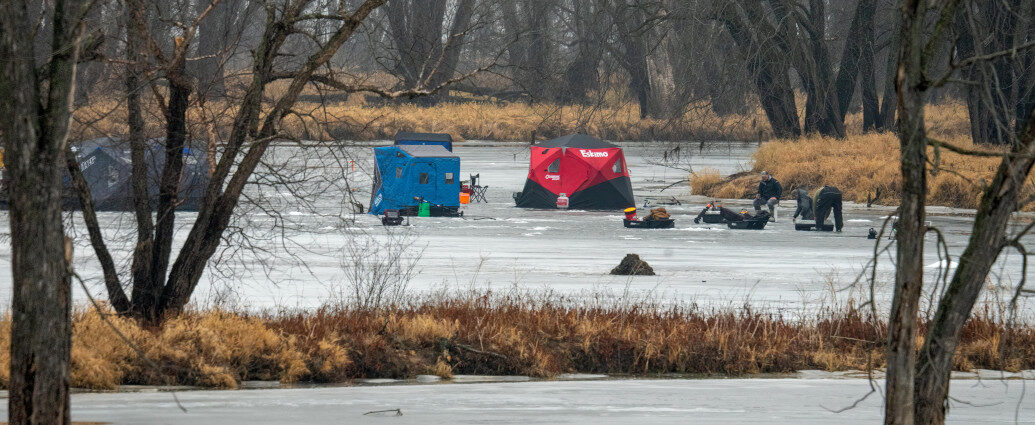

The first thing people get wrong about ice fishing in the Minnesota Driftless is that they assume it’s about the fish.
It isn’t.
Not really.
There are no endless frozen lakes stretching to the horizon, no wide-open prairie winds racing unchecked across flat land. Instead, winter here tucks itself into coulees and creek bottoms, into hardwood hillsides and limestone bluffs that rise quietly above frozen water. The snow settles differently in this landscape—softer, uneven, shaped by elevation and shadow. The cold feels older somehow, less performative. It lingers.
When the ice finally sets along the backwaters of the Mississippi River or on the smaller, tucked-away lakes scattered through southeastern Minnesota, it doesn’t feel like a season beginning-It feels like permission being granted.
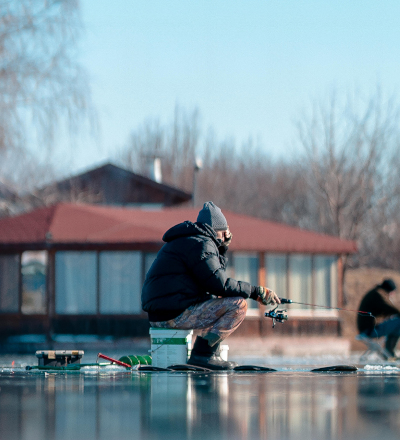 Long before I understood ice fishing as solitude or ritual, it existed for me as memory—messy, loud, half-frozen memory.
As a kid, winter fishing wasn’t about stillness. It was about movement and noise and the kind of impatience only children possess. Ice fishing meant piling into a truck that smelled like wet wool, gasoline, and old minnows. It meant boots that were always a size too big, socks that never stayed dry, and mittens clipped together on a string so they wouldn’t get lost—though one always did anyway.
I don’t remember much about the fish themselves from those days. What I remember are fragments: the way my dad’s voice sounded deeper in the cold, the scrape of metal skimmers against ice, the feeling of being trusted with a tip-up for the first time. I remember learning how to watch the flag—not because I was patient, but because I was told to be.
As I grew older, winter fishing changed shape. The noise faded. The groups got smaller. Eventually, there were days I went out alone. The same silence that once bored me became the reason I stayed. The ice that once felt like a playground became something I read carefully, respectfully. The frozen surface might look flat at first glance, but you learn quickly that nothing here is uniform. Springs bubble invisibly beneath you, reminding you that this region was shaped by water long before it was ever frozen.
Ice fishing here demands attention. Not the frantic kind, but the quiet, observant kind. Out here the Driftless reveals itself in layers. You watch the color of the ice and listen for hollow sounds under your boots, moving carefully—not out of fear, exactly, but out of respect. You read the snowdrifts, the way they feather and collect along pressure cracks or drift thin over flowing water. It’s a practice that rewards patience and punishes arrogance.
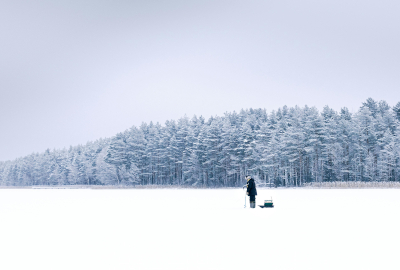 That patience extends to the fishing itself.
You don’t always catch much. Some days you don’t catch anything at all. But the act of drilling a hole through clear, dark ice—watching the spiral of shavings curl up toward daylight—feels like opening a small window into another world. The water below is impossibly calm, a slow-moving universe of shadows and suspended life. You drop your line and wait, not expecting immediate results, by now you know better.
Waiting becomes the point.
There is a particular silence that settles in once you stop moving, once the auger is put away and the shelter is set—or deliberately left at home. It’s not the absence of sound so much as the presence of subtle ones. Ice shifting and groaning like something alive. A distant eagle calling from a cottonwood along the river. The faint hum of traffic miles away, softened by snow and hills until it barely registers as human noise.
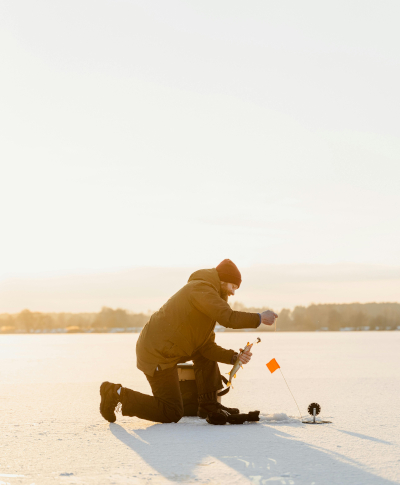 Time behaves differently out there.
You stop checking your phone. You stop thinking in hours and start thinking in light—how it slants across the bluffs, how long the shadows are getting. You think about the next cup of coffee, the way it will taste in the cold. You think about nothing at all.
Ice fishing in the Driftless has taught me how uncomfortable stillness can be at first. We’re trained to measure value by productivity—by results, by outcomes, by things to show for our time. Sitting on a bucket over a hole in the ice challenges that instinct. It asks you to justify your presence without proving anything.
Some days, the fish cooperate. Bluegills flare into view like small coins, flashing and disappearing. Crappies rise slowly, inspect your offering, and either commit or fade back into the dark. Northern Pike cruise the edges, their presence announced by sudden tension on a tip-up line and a brief burst of chaos that breaks the spell before returning to quiet.
But even when the fish don’t bite, something else happens.
You notice the landscape more deeply. The way frost feathers across your gloves. The way the sun warms one side of your face while the other stays numb. You think about the people who stood on this same ice generations ago—long before portable heaters and lithium batteries—relying on this water for survival rather than solace.
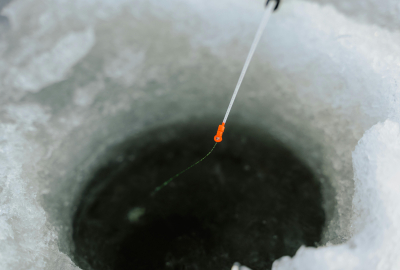 The Driftless has a way of holding history close. Its lack of glacial scouring means the land remembers. The hills remember. The rivers remember. And in winter, when everything is stripped down to essentials, you feel closer to that memory.
There’s humility in ice fishing here. You are never fully in control. Conditions change quickly. Ice shifts. Weather moves in faster than predicted. You learn to turn back when something doesn’t feel right. You learn that leaving early is not failure. You learn that success can look like getting home safely with cold fingers and a clear head.
Some of my favorite days on the ice have ended with empty buckets.
They end with the long walk back to the truck as dusk settles into the valleys, the sky turning that particular pale lavender that only appears in winter. With the sound of boots crunching over the snow and the quiet satisfaction of having spent the day exactly where I was supposed to be.
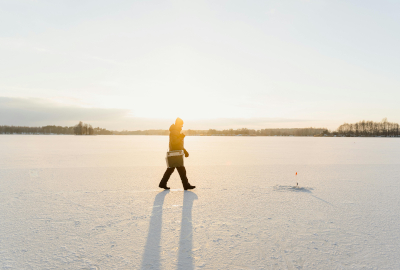 Ice fishing in the Minnesota Driftless isn’t flashy. It won’t always make for dramatic photos or impressive numbers. It doesn’t promise certainty. What it offers instead is something rarer: a relationship with place that deepens over time.
Each season teaches you something new. It teaches you to listen—to the land, to the weather, to your own instincts. It reminds you that rest is not the same as idleness, and that stillness can be active work. It reminds you that winter is not something to endure, but something to enter willingly, with curiosity and respect.
When spring finally comes and the ice pulls back from the shore, I feel a familiar mix of relief and loss. The rivers open, the hills breathe again, and the world speeds up. But I carry the quiet with me—the memory of standing alone on frozen water, surrounded by bluffs and sky, waiting without needing anything to happen.
That’s what ice fishing in the Driftless has given me.
Not just fish, but perspective. More than just a way to pass winter, but a way to understand it.
Memory, like ice, holds layers. Beneath the quiet surface are voices, warmth, motion. Every year, when the ice is thick enough and the land says yes, I go back out. I drill my holes. I pour my coffee and I wait, without urgency. Because I realize I’m not alone at all. I’m accompanied by every winter that came before—by frozen mornings, red mittens, dented thermoses, and the long, patient learning of how to be here. Because some of the most important things in life don’t arrive with a bite—they arrive in the space between moments, under the ice, in the quiet heart of the Minnesota Driftless.
By Jonathan Wilder